


“…they shall beat their swords into plowshares, and their spears into pruning hooks….”
—Isaiah 2:4; Micah 4:3
As I was scrolling for a movie to watch the other day, I happened upon the 2024 documentary Secret Mall Apartment. The film tells the story of a group of artists from Providence, Rhode Island, who built a clandestine apartment inside the Providence Place shopping mall and used it, undetected, for four years (2003–07). “No way,” I thought. “How did they pull that off?” My curiosity got the better of me, so I hit play.
As the film progressed, however, I came to realize that the creation of the secret apartment was only nominally its focus. The real subject of the documentary is the artistic imagination of a group of friends led by their ringleader, Michael Townsend. Townsend is one of those intensely creative types some of us are privileged to know, someone always looking for ways to concretize his imaginings and, in the process, playfully blur the line between art and life. These are my favourite kinds of people, because they help me see with new eyes and enliven my imagination to possibilities I had not noticed before.
As the film bears witness, Townsend has a deep, if implicit, grasp of the healing and transformative power of collective acts of creative imagination. We see his team at work in a children’s hospital, helping young patients create tape-art murals that beautify cold, clinical spaces. We see how the collective art project gives the children a sense of agency within an environment that might otherwise feel frightening and alienating during an especially fraught time in their lives.
The film then follows Townsend and his cadre of “possibilizers” as they take their tape-art practice on the road, first to Oklahoma City, where they commemorate those killed in Timothy McVeigh’s horrific act of domestic terrorism, and then to Manhattan. There, over several years, the group carries out an audacious plan to memorialize the victims of the 9/11 terrorist attacks by creating thousands of tape-art murals tracing the outlines of four heart shapes superimposed on a map of the island.
By this point, I found myself moved by the documentary in a way I hadn’t expected, and in a way that has stayed with me. I had not anticipated that the film would so clearly demonstrate the redemptive power of art: its capacity to memorialize collective suffering while simultaneously helping us imagine how our home places might be otherwise, how they might become spaces that foster healing rather than perpetuate brokenness.
Both the tape murals and the secret mall apartment are experiments in reimagining our built environment by attending to what designers call negative space: possibilities that exist not because of, but in spite of, the original intent of a design. Negative space is what we don’t initially see, even though it provides the condition of possibility for what we are meant to notice.
In medieval church architecture, one thinks of the spandrels formed where a column meets an arch. Though they arise indirectly from other, explicit design intentions, once they exist they open up space for further artistic expression, as evidenced, for example, in St. Mark’s Basilica in Venice. A more mundane illustration is the forward arrow formed in the negative space between the “E” and the “X” in the FedEx logo. I still can’t believe how many people don’t see it.
If negative space can hide an arrow in a logo, it can also conceal far more troubling realities in the social worlds we inhabit. John Prine penned a devastating line in his song “That’s How Every Empire Falls”: “If terror comes without a warning, there must be something we don’t see.” Prine’s point, I think, is that terror, too, has its own negative space, its own condition of possibility. If we fail to notice these conditions—the accumulated trauma, fear, and hatred that precede acts of terror—we should not be surprised when violence erupts seemingly out of nowhere.
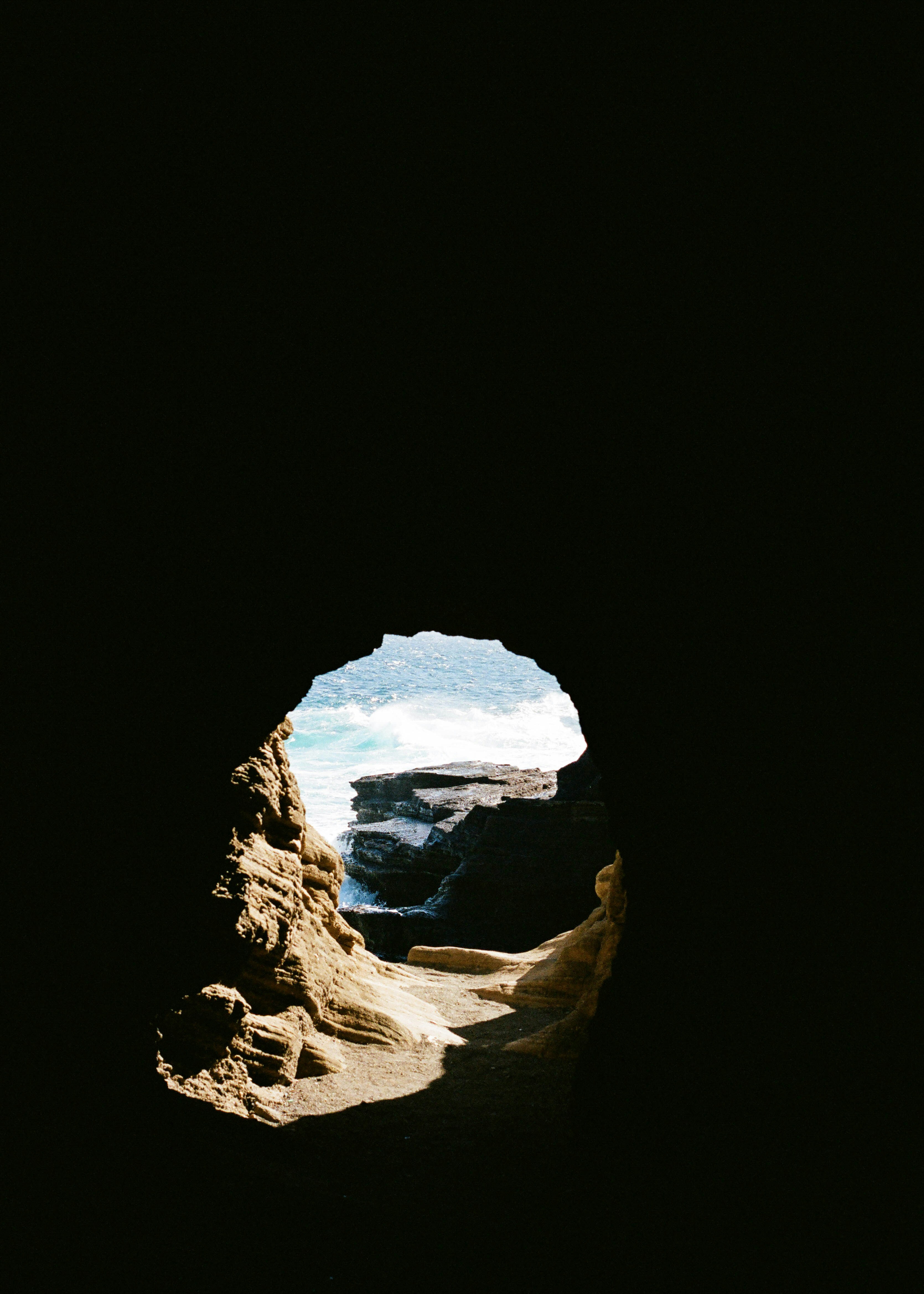
Yet noticing these conditions requires attentiveness to another kind of negative space altogether: the condition of possibility for justice and peace, for shalom. This is the space Jesus names the Kingdom of God, the realm of shalom that exists even amid the oppressive realities of the Roman Empire (Luke 17:21). In this passage, I hear Jesus urging his followers to attend to a peculiar kind of absence: a reality already among them, but largely unrecognized. He is also suggesting that no empire will ever succeed in eliminating such space, such possibility, by sealing reality shut. There will always be gaps, margins, leftovers: spaces empire overlooks, where imagination can dwell and meaning can be reoriented.
Every system leaves something out, not because it is merciful, but because it is finite. What it cannot account for, it ignores. And in that ignorance, possibility waits for an imagination attentive enough to notice it.
Perhaps this is what the prophets glimpsed, and what Jesus tried to train his followers to see: not an otherworldly escape from history’s violence, but rather the strange and fragile possibility that even the instruments of violence might yet be reoriented.
That a sword could become a ploughshare, a spear a pruning hook.◆
Thanks for this. I especially love the image of the 'kingdom' of God as the grace that inhabits those negative spaces. It makes new sense for me of the sayings that the 'kingdom' of God is within/between/among you. It takes its place in those cracks and crevices that empire cannot touch!
I may be out in left field but this seems to be a deeper dive into opportunities from sayings like : “you have to have a death to have a resurrection.” Minneapolis as an example. Challenging me. Thank you.
PS I’ll not see the FedEx logo the same again!